Managing the Personal with the Professional During COVID-19

By Beth Bolthouse, MA, MS, LPC

(Originally published in the Michigan Counseling Association April 2020 Newsletter)

As counselors we are the ones who are the “go to” when others are hurting, stressed, feeling alone, having challenges, going through difficult times.  So what do we do when we are in the midst of a worldwide pandemic that affects not only our clients, but also our family, our friends, and even ourselves.  I’ve found myself the past several weeks working from home, providing care and support to others and realized (after losing sleep and experiencing some irritability) that perhaps I’ve not been applying my own counsel.  Here are some things that have been helpful to reduce my own stress and anxiety levels during these days of COVID-19:

  • At the end of the day, take off my professional “hat” and remember I’m a human being with a personal life, including acknowledging the experiencing of day-to-day stressors many others are going through.
  • Mindfulness applies to me as well as my clients, therefore be intentional about choosing my focus each morning before getting out of bed, and throughout the day as things unfold.
  • Physical activity matters, even if it is getting up and going outside to take in fresh air, walking around the house, taking my dogs out more frequently, or deciding to finally clean out that closet which somehow became filled with miscellaneous storage.
  • Journaling isn’t just for clients; it is a great tool for me to express my feelings, thoughts, hopes and help me keep my focus in a good place.
  • Spirituality is an important way to maintain a sense of peace and calm, whether it’s through prayer, music, meditation, connecting with a friend online or through a phone call, or watching the YouTube video of a spiritual mentor. 

As we continue making changes in our professional lives to accommodate the needs of our clients, we also can find creative ways to ensure we meet our own personal needs.  Reaching out for emotional support from a trusted friend or colleague can go a long way toward helping us manage our own hearts and heads so we continue to provide meaningful support to those who are hurting.

Grief and Loss and COVID-19

By Beth Bolthouse

March 16, 2020

It feels like someone in Hollywood found a long-lost episode of

The Twilight Zone and somehow plugged it into an outlet located beneath the surface of the earth. Here we are in 2020, no Rod Serling, no black and white tv, no piano doling out 4 little repetitive notes to warn us of impending danger – yet life feels as though we have been dropped into another type of dimension.

The surrealness of going from the day-to-day mundane routines into the suddenness of anxiety and unknowns as places get closed and stores run out of staples and people isolate with intention feels like something turned the world upside down and no matter how much we all try to get it to turn back right-side-up, we will never be able to.

Tonight, I sit in my recliner watching a press conference instead of welcoming folks into the Monday night grief group that has met regularly for nearly thirteen years. For me, as well as for those who attend often, tonight is a loss. This group is intended for adults whose loved one(s) have died, whether recently or a few years ago. We talk about our grief, share memories, sometimes tears and laughter, and most of all provide encouragement and emotional support to be able to get through the tough times and make it along this journey of grief.

Yet something else has died, too and I am not referring to a human death. Rather life as we knew it a couple weeks ago has ended. And we are grieving this new reality, this unwelcome change, this very real time of additional loss. And as with the changes which are a result of loss, things will never fully go back to the way they used to be.

This loss a type of disenfranchised loss – the kind that is not recognized as a loss, yet we are all grieving in various ways, perhaps not even realizing it. Take the people who raided the toilet paper shelves at every store and online site – perhaps because of the fear and anxiety which accompanies a loss that is not recognized or acknowledged. Or the woman in the checkout line who freaked out because a cashier did not use hand sanitizer before touching her groceries. Or the man who yelled at his child for taking the last bottle of water out of the fridge. These extreme reactions betray the fact that this experience is filled with losses:

  • The loss of security
  • The loss of safety
  • The loss of trust
  • The loss of normalcy
  • The loss of freedom
  • The loss of health
  • The loss of stocked shelves
  • The loss of confidence
  • The loss of answers

(just to name a few)

man in red jacket wearing white mask
Photo by Julian Wan on Unsplash

We as a country, in our communities, as individuals and families are experiencing a

tremendous amount of loss as a result of COVID-19 and not taking time to acknowledge it – which in turn intensifies the grieving we are all doing, and that increases the fear, anxiety and panic that can only take us deeper into negative realities.

So what do we do in response to all this disruption, turmoil, and unknowns?

The first best thing we can do is take a few moments to honestly acknowledge the losses we are all experiencing. To make a mental checklist, or better yet, to write down a list in a notebook or journal. Itemize the losses you are realizing on a daily basis and then add a brief sentence about how they each make you feel. For example:

  • Loss of stocked shelves – I feel angry that I am unable to buy toilet paper anywhere and I worry about running out completely.
  • Loss of freedom – I feel sad and frustrated that my plans for meeting a friend for coffee are not possible due to this virus.
  • Loss of trust – I feel worried and concerned that I do not know who in the media or government is telling the full truth.

Continuing to acknowledge and validate the loss(es) and emotions you experience on a daily basis will most likely accomplish two things: 1) it will release what’s pent up and running through your mind already; 2) it will give you a sense of empowerment that comes from expressing your truth.

The second-best thing we can do is start a gratitude list – each morning write down the good things that have happened in the past 24 hours. Try not to be repetitive; reflect on yesterday and look throughout today for what you would like to include in your list the tomorrow morning. Some examples:

  • I’m grateful to be able to see outside while I work from home.
  • I’m grateful that Domino’s still has home delivery.
  • I’m grateful that I can stay in my PJs while participating in a conference call.
  • I’m grateful that we have not run out of toilet paper yet.

The reality in this time, this COVID-19 dimension, is that we will make it through – perhaps looking at life much differently than we ever have before. Yet bottom line we are not a virus – we are human beings capable of managing, maneuvering and navigating the hard and challenging things that life throws at us. Taking time to acknowledge both the losses and the blessings frees us to do what we do best – love each other with meaning and purpose so that when life returns to a type of “usual” we can be stronger than we ever were before this loss.

Guilt vs Regret

Beth Bolthouse, MA, MS, LPC

How can we have guilt-free happiness? How do we get away from all the regrets from years ago and not give in to debilitating feelings of guilt today?

First of all, it’s important to distinguish between guilt and false guilt. Feelings of guilt are normal and appropriate when we have done something to harm or hurt another person (whether intentionally or not).  When we recognize that we have mistreated another person, guilt helps us realize what we’ve done and gives us a choice to seek amends and make things right.  Sometimes we are not aware of hurting someone else, so if we realize it at a later time, then we may need to talk with them, apologize and do what we can to try to heal or restore what we are responsible for in the relationship or situation.

The reality is, however, most of the time when we feel guilt about something it is not the result of hurting or harming someone else.  If we’re honest with ourselves, we tend to feel guilty for not cooking a better dinner for our family, or for being goofy around friends instead of more mature, or not doing more to help make others happy.  The reality is, MOST of the guilt we feel is false guilt. 

False guilt leads us down the spiral of negative thinking, self-condemnation, and takes us into rabbit holes of insecurity, self-doubt and it can be hard to find our way back to what is truthful.

So what do we do with the false guilt?  How do we stay out of the negative spiral?  First of all, it’s important to identify it as REGRET.  Regret is about wishing something had been different, or we could have done more, or things had gone better (James, J. & Friedman, R. 2017. The Grief Recovery Handbook. William Morrow Publishing.)  Recognizing false guilt as regret gives us an opportunity to look at a situation, or recall memories, or identify our or another person’s role in the context of what we wish something had been. 

For example: “I remember my mother made one of my favorite meals for my birthday and went all out to make it a special day. But I was late so by the time I got home for dinner everything was cold. I should have been there sooner.  I feel so guilty for letting her down.” 

What is the emotion you feel?

That type of statement does two things:  First, it takes me into shame by using the “should” word; and it takes the focus of the loving way she remembered my birthday by focusing on my guilt. Neither of these responses is healthy nor do they enable us to enjoy a memory that meant a lot to us.

Recognizing that the guilt we feel is actually regret helps us to reframe the same memory with a recognition of what we wish we had done differently:

“I remember my mother made one of my favorite meals for my birthday and went all out to make it a special day. I was late so by the time I got home for dinner everything was cold. I wish I could have been there sooner.”

What emotion do you feel reading it now?

Reframing the memory this way does two things – it removes the false guilt, and it takes the shame and blame (“should”) and replaces it with “could” to identify what could have been done differently and focuses on what Mom did for me.  Using “could” also reminds us that we are not perfect and next time will hopefully do better.

Guilt can become baggage that takes on a life of its own.  It’s no surprise that someone coined the expression, “Going on a guilt trip,” because guilt never leaves until we set it down or throw it away.  It can take us on a never-ending ride on a self-made shame-train we can never get off.

If we have done something to hurt or harm someone else, then guilt is an appropriate feeling so we can make amends and let the guilt go.  If the situation we are feeling guilty about relates to a living person, then swallowing our pride and apologizing while also choosing to not repeat the same behavior will lead us out of guilt. This may need to happen more than one time especially if we have difficulty changing behavior.  If the person is not willing to forgive us, we need to let them have their feelings and choose not to forgive us.  We are not responsible for whether or not someone forgives us when we have sincerely apologized and made amends.  If we take on guilt because they have not forgiven us then we are making everything about us again, without recognizing that they may need time to process things.  Some hurts make it difficult for the other person to trust us again, so we may need to be intentional about living in such a way that trust can be re-built.

If the situation we are feeling guilty about relates to someone who has died, it can feel like we will never be free from guilt.  They are not here for us to apologize to or make amends to in person.  Writing them a letter of apology and amends may not seem like it is enough, yet if we sincerely mean our words, it can make a difference.  Reading the letter out loud to them at a gravesite or in front of their picture helps us to express what we have not expressed.  Making amends may mean we do something in their memory to help make up for the hurt, or it may mean we choose to change the way we have always done things, or it may mean living more purposefully to honor them as well as our own values.  Once we have apologized, the guilt may try to pack another bag for another guilt trip.  Yet you are the one who can prevent this from happening by reminding yourself that you apologized, you are making amends, and you do not need to feel guilty any longer.  It can take time to not feel the guilt, but if you use your mind to tell yourself the truth soon your feelings will follow and the guilt will have to leave.

If we struggle with false guilt (whether the person is living or has passed on) then we need to look at the situation and identify the regret:  what do I wish had been better?  What do I wish I could have done more about?  What do I wish I had done differently?  Once I identify the regret, that gives me an opportunity to consider how I might change things and/or myself moving forward.  Regret can be empowering to choose new pathways for myself in my relationships and life.

Positive Aging

Photo by Vladimir Soares on Unsplash Photo by Johnny Cohen on Unsplash

Beth Bolthouse, MA, LPC

Last year I turned 60, which came as quite a shock, to be honest, because in my mind I’m still an energetic, fun-loving 20-something.  Of course there were hints leading up to this birthday that I’m not as young as I used to be.  For one thing, my bones hurt.  Especially when the weather does certain things.  It’s amazing how much more accurate bones are than most meteorologists.  For another, at times it’s a struggle remembering words for common things – such as, well, you know, that thing you use when you open your car door and then you put it into the slot so your car starts – oh yeah KEY!  That thing. 

Realizing there may only be 20 (possibly 30) years left caused me to step back and reflect on who I am now, and what the rest of my life looks like.

Sociologist Lars Tornstam developed the theory of “Gerotranscendence” to describe the final stage of maturation development. Based on two terms, “gero” meaning aging, and “transcendent” meaning rising above, Tornstam’s research found that elders who engage in positive aging have some distinct characteristics, including:

  • Less self-centeredness and materialism
  • Greater desire to find inner peace and experience positive solitude
  • Less interest in prestige, social roles, and superficial socializing
  • More concern for others
  • More spontaneity, tolerance and acceptance
  • Emphasis on altruism and volunteering
  • Finding joy in small or insignificant things
  • Feeling more connected with past and future generations
  • Realizing the larger role one plays throughout history
  • Reduced fear of death (even if there is some apprehension about the dying process itself)
  • More intentional about choices; choosing to remain active, productive, independently engaging in more meaningful activities (art, nature, music, etc.).

Positive aging is about making choices that provide opportunities to live life on purpose, including what end of life might look like.  Having advance directives in place or other legal documents to ensure that our family members know our desires ahead of time can be empowering and free us up to focus on life rather than death.

Perhaps gerotranscendence can be summed up as follows: “This isn’t your grandpa’s old age!” Growing old does not mean we have to live the stereotypical old age of the past.  Rather, today there are opportunities to age with dignity and live the rest of our life on our terms.  The images of Mr. Wilson and Fred Sanford are being replaced more frequently by those of Blanche, Dorothy, Rose and Sophia.  Perhaps it could be said that gerotranscendence is the secret that turned those frail grumpy old people in Cocoon into vibrant thriving older people with purpose and joy for living life intentionally.

Positive aging is here for you and for me, in spite of bones and that word that we just can’t quite put our finger on!  It only requires intentionality about living out the rest of our lives.

Tornstam, L. (2005). Gerotranscendence: A developmental theory of positive aging. New York, NY: Springer Pub. Co.

Article published in Senior Perspectives May 2018 issue – https://seniorresourceswmi.org/senior-perspectives/ (distributed and published by Senior Resources (https://seniorresourceswmi.org).

3 Cs to Help You Manage Life’s Changes

Photo by Manny Becerra on Unsplash

Beth Bolthouse, MA, MS, LPC

Growing older means we experience more changes, and each change involves a loss of some kind. If a loved one died, we may ruminate about their final days, reviewing decisions that were made.  Health issues can impact our lives; we wonder how to continue things we enjoy.  Other losses may contribute to a sense of uncertainty about the future.   Sometimes we beat ourselves up for what we did or didn’t do instead of affirming the ways we handled difficulties in our lives.

Language is a powerful tool that can empower us to find positive and helpful ways to deal with loss.  Ken Doka has identified 3 C’s of empowering language that can make a difference in what we tell ourselves as well as how we communicate to others: Challenge, Courage, Confidence (Doka, 2018).

First, it’s important to evaluate and CHALLENGE our belief system – about ourselves, others, the world, even God or spirituality.  As we age, we realize that what we used to take for granted can be disrupted without warning.  We may question many of the things we used to take for granted or believed to be true.  Things happen that turn our world upside down, and we are not the same.  We doubt what we used to trust, and fear what we used to feel confident about.   Identifying and acknowledging our questions, doubts and worries helps us move into the next C – Courage.

First, COURAGE involves accepting the consequences of change – one of the most difficult yet most important things to do.  We tend to resist facing and accepting how we are affected. Some consequences are physical (for example, moving to a different home); some are social (people we counted on have detached); some are financial (not having money to pay bills); some are spiritual (loss of faith or trust); some are mental and emotional (increased anxiety or feelings of insecurity). 

Next, reviewing boundaries with ourselves and others helps us become more empowered during change.  A boundary is simply deciding what “good” we would like to allow in our life, and what “bad” we would like to keep out. When bad things happen beyond our control, we still get to decide how we will think, feel and act regarding it.  We cannot necessarily control what happens in our lives, but we can control our response or reaction to what takes place.

Third, embracing who we are now and who we will continue to become gives us the courage to realize that we are growing and changing.  Acknowledge that growth and healing is a process; choose to accept that it is okay where and who we are now.  This helps us look forward to the future as the beliefs and boundaries we are working on continue to develop.

Facing the future, we can set small goals and feel successful; we can set big goals and adjust them as needed builds our CONFIDENCE.  There is no failure; we choose our thoughts and find positive ways to express them.  This includes replacing “I should” with “I will,” increasing self-respect.  Replacing “I have to” or “I can’t” with “I choose to” or “I am not willing to” reminds us we have choices.  Replacing “I should have” with “next time I can” reminds us of opportunities rather than obligations.  These shifts in thinking and communicating help us grow in our confidence.

Gratitude is a valuable tool which helps us to move through each of the 3 C’s. Life happens, losses have affected us significantly, and things will continue to change, but we focus on gratitude to empower us regardless of the changes that take place.

Bolthouse, B. (2019). From loss to life: how to transform your life after traumatic loss.  Muskegon, MI: Author.

Doka, K. J. (2018). Growth in grief: A historical perspective.  In K. J. Doka & A. S. Tucci (Eds.) Transforming loss: Finding potential for growth (pp. 5-17). Washington, DC: Hospice Foundation of America.

Article published in https://seniorresourceswmi.org/senior-perspectives/ Senior Perspectives March-April 2020 (distributed and published by Senior Resources (https://seniorresourceswmi.org).

Our Definition of Grief

By Beth Bolthouse, MA, LPC (with help from the Monday Night Grief Healing Support Group)

One evening in June, the participants in our weekly “Grief Healing Support Group” got together and do what we always do – talk about our grief.

The remarkable thing about this group, however, is that it is not a sad, gloomy hour. Which may surprise some of you. When a person thinks about going to a grief group, that is usually the reaction (“I don’t want to go and be more sad”). Now that doesn’t mean that no one ever feels sad or gloomy while there. But the focus of this group is to be gut level honest, talk about the ways losing someone we loved (or at least knew, because it isn’t always about an actual “loved” one), has affected our life and changed the person we used to be to who we are now.

Most of the folks who come to group are still trying to figure that out. And almost all of them admit that people in their lives want them to go back to how they were – which is an impossibility. The death of the person who impacted their lives in one way or another has changed them and they cannot possibly be who they once were.

In fact, they don’t really know who they are now, or who they are going to be. They are just trying to sort through all the emotions and thoughts that have gone into this time in their lives and find ways to maneuver through the sometimes chaotic and crazy-making, other times numbing and depressing day-to-day, hour-by-hour, minute-by-minute grief experience.

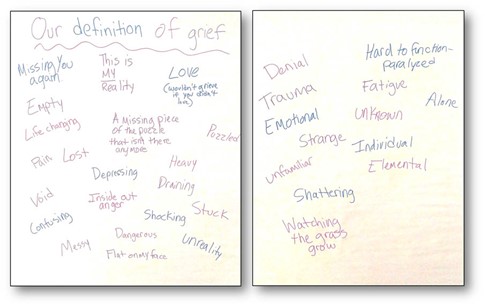
The plan for group this night was to take time to define grief. What really impacted this particular evening were two folks who brought in their own ways of viewing grief, without being aware of what the plan was in advance. That’s one of the things I love about this group – people come as they are, and once in a while they bring a guitar, or a framed poem they wrote, or old photographs and we all get to be a part of their experience in a deeper way.

There are all kinds of deaths represented in this hour each Tuesday: spouse, parent, child, grandparent, sibling, friend. And there are all kinds of people represented through their varied cultural backgrounds, faiths, life experiences. But the one thing we all have in common is grief. With a capital G.

And the other thing we all have in common is we talk real – no one fakes their feelings, or hides their tears, or pretends things will be okay. Cuz truth be told, no one knows what tomorrow will be like, and perhaps just getting up and driving to group was all that a person could do today.

One of our group members likes to write songs to express his grief, so he passed out copies of lyrics and proceeded to share a song he wrote about his loved one and how his grief feels. Titled, “Missing You Again,” it expressed the heartfelt pain of his loss.

Perhaps you can relate to missing your someone – again – and again – because if we’re honest, the missing never stops. It may change in intensity, or we might have different things that remind us of him or her, but the reality is we never stop missing them because that is the way grief is.

It took us about an hour (and we could have gone on longer if we had stayed), but we came up with our own definition of grief – words and phrases that are the true life experience of at least one or more folks who were present that evening.

What about you?

How would you define your grief?

Do words or phrases come to mind? Or a song? Or perhaps you would create your definition through a drawing or sculpture?

It’s important to acknowledge the losses in our lives, and to find ways to identify how they affect us and use those things to define our individual grief.

Your losses matter.

Your griefs matter.

You are not alone. We are here to help.

Call us at the Scolnik Healing Center of Harbor Hospice at (231) 728-3442 if you would like to join one of our grief groups, or perhaps sit down with a grief counselor and begin (or continue) the process of defining your grief.

Daddy God

dadsarmsbwA few months ago I opened my home to a young woman in need of a place to live.  She has some special needs.  Not in the way you might think of at first.  But she has a way of relating that catches you off guard because of how she was raised.  Make that how she wasn’t raised.  By a mom.  Who loved her.  Who nurtured her. Who taught her the basics of relating. Who modeled goodness.  Who gave her basic life skills.  Not.

It is what she did not receive growing up that has kept her from doing life according to society’s “right.”  Kept her from wearing the appropriate masks we don in society so others will like us, so we will be acceptable.

Although many things about her life and mine are parallel, there are many differences.  Abuse comes in all shapes and sizes and religions.  I often think that people who come to Christ when they are older have the advantage of not struggling with the religious angst those of us do who experienced abuse in a “christian” home.

There are aspects of her faith that are so innocent, at times I have found myself embarrassed for her. But gradually God has used it to reveal the shallow existence of living I have defined faith by.

The reality is, she trusts God.

I don’t mean she trust God like I do.  Which is kind of like “I trust you God and am hoping you will come through” (because, let’s face it, I’m still in a journey of knowing God as himself and not as the face of my father or the variety of men who have so horribly abused and abandoned me).

She trusts God like he is really for her.

An unknown emerges?  “Well, I’ll just trust God and he’ll take care of it.”  Something she can’t control?  “Well, I’ll just trust God and he’ll take care of it.”  Uncertainties?  Questions?  Big things?  Little things?  Extremely small things that probably don’t matter much?  “Well, I’ll just trust God and he’ll take care of it.”

Matter-of-fact.  Done. Finito. It’s over.

Blind trust.

Childlike trust.

Innocent trust.

Trust that believes, really believes, in a God who is so involved in her life that if she doesn’t know something, she knows he is there.  So she just trusts Him.

I overheard her praying once.  Not trying to listen, and yet found myself mesmerized by the intimate way she talked to Him.  Like a little girl telling her safe Daddy the things she feels, expressing her worries, asking for help for herself and others.

As much as I like to think I’m trusting God, experiencing how she involves him in simple ways throughout the day has shown me the gaps in my faith.  And I am humbled before God’s loving Daddy expressions of gentleness and kindness. Realizing he has been waiting for me to reach out to him in deeper levels of trust – childlike trust – has opened a new door of relating to my Abba, my Father, my Daddy.

What is it like to have a real Daddy?  I honestly don’t know.  And that has gotten in the way of knowing God from a daughter’s perspective.

But I’m willing to let him show me.

What is a Daddy, God?

How do I be a daughter to you, God?

I don’t know where to start because of all that I never received growing up.

“Well, I’ll just trust God and he’ll take care of it.”

keep going

Image

I have to remember this.  It’s hard tho.

Days and weeks go by and then -bam- I am hit with the reminder of a significant loss. The pain goes deep, the tears fall without effort, the thoughts of despair begin their descent into the deepest parts of my hurting heart.

At times it’s hard to know whether it’s the grief or warfare-related.  Perhaps a combination.  Certainly the enemy uses it to get me off track in my thinking and then the focus becomes dark and troubled.

The journey to reframe my thoughts is so important. Reminding myself of purpose (God’s) and belonging (I do) and family (His). 

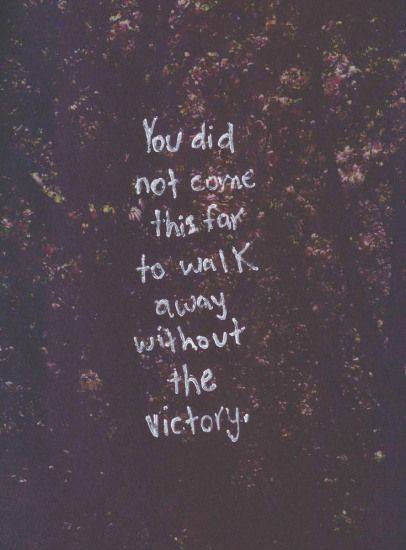
I didn’t come this far to walk away without the victory.

“Now this I know:
    The Lord gives victory to his anointed.
He answers her from his heavenly sanctuary
    with the victorious power of his right hand.
Some trust in chariots and some in horses,
    but we trust in the name of the Lord our God.”  (Psalm 20:6-7)

It’s coming.  Keep going.


mountain tops

Image

the devotional reading this morning was about being on the mountain top with Jesus… and then we come back down into the valley of community where we live our lives and go through our normal routines.

it caused me to consider whether the

Mountain Top

is really not what I have been thinking it was all along.

the tendency is to think of the “Valley” as the struggle, and the “Mountain Top” as the joy and exuberant experience of coming out of the darkness of trials.

today I started to consider – if the “Mountain Top” is where I get to commune with God in deeper ways, bask in the Light of His Presence, be more at one with Him than ever before… then isn’t that what happens in the midst of the struggle, when I feel the least amount of hope, where I am more aware of aloneness than ever before?

isn’t the darkness of challenges and trials where we meet God in life changing, transformational ways?

doesn’t His Light shine more brightly when I’m in the pit of despair?

what if the joy in the trials that James encourages us to embrace is only possible on the top of the mountain where we have a clearer view, because of what we are in the midst of.

Maybes this is when my ability to focus is at its blurriest and also at its clearest.  Blurry because I have a difficult time understanding when I’m in dark places and not being able to make sense of things. Clear because it allows me to focus solely on God and be more aware of His Presence and His Peace than ever before. 

This is when utter trust and dependence takes place.

Perhaps the Mountain Top experience I long for when I’m hurting is already here – I just need to be willing to stand up to see it from His viewpoint.

And then when I go down into the valley of life, where there are so many distractions and not enough time to spend with Him, I bring just a little bit more of the Mountain Top perspective with me.

wide-eyed

(originally written 2/16/09)

Sitting at my computer tonight listening to “Wide-eyed” by Nichole Nordeman, wondering the same thing she expresses in that song – if I had been there “back in the day” would I have sat listening to Jesus, and casually dismissed him as a fraud, or would I have been wide-eyed at the realization I was staring at the image of God? And how would that have changed me and impacted the ways I deal with woundedness?

I found myself revisiting old heart-pain today, wondering how much hurt does the body of Christ have to inflict upon each other (forget the world – we do it so well within our own circles) until the mountains cry out “no more!” Prayers to let these wounds from the past 2 years go didn’t seem to have a releasing effect. And introspection revealed I was working hard at denying the hurt that was still inside which, when someone or something barely touches it, causes the wound to gape open again; my heart bleeds out, and in a panic I try to bandage it back up. Maybe it just needs to bleed. Maybe tears just need to overcome me until I’m awash in a flood of liquid anguish.

There’s no answer. There’s no closure. Thank God for time because these feelings don’t come as often, but when they do, it’s too painful to write about even.

Dearest God you are the one true God… I want to sit wide-eyed and listen to you, hear your voice, experience your love, and not give a care of what the rest of “Christianity” does. I want to find myself staring at you and becoming overwhelmed with the truth of your power, amazed at your God-ness, filled with the power of your Spirit. Take this pain and turn it into something glorious that heals people for you. Take my broken bleeding heart and transform it into the most beautiful softness that looks like your love. Take my flood-producing tears and use them to flow living water into the lives of others.

And I will sit wide-eyed, amazed at you, the God-man, and fall in love with you all over again.