Category Archives: Articles

Guilt vs Regret

Beth Bolthouse, MA, MS, LPC

How can we have guilt-free happiness? How do we get away from all the regrets from years ago and not give in to debilitating feelings of guilt today?

First of all, it’s important to distinguish between guilt and false guilt. Feelings of guilt are normal and appropriate when we have done something to harm or hurt another person (whether intentionally or not).  When we recognize that we have mistreated another person, guilt helps us realize what we’ve done and gives us a choice to seek amends and make things right.  Sometimes we are not aware of hurting someone else, so if we realize it at a later time, then we may need to talk with them, apologize and do what we can to try to heal or restore what we are responsible for in the relationship or situation.

The reality is, however, most of the time when we feel guilt about something it is not the result of hurting or harming someone else.  If we’re honest with ourselves, we tend to feel guilty for not cooking a better dinner for our family, or for being goofy around friends instead of more mature, or not doing more to help make others happy.  The reality is, MOST of the guilt we feel is false guilt. 

False guilt leads us down the spiral of negative thinking, self-condemnation, and takes us into rabbit holes of insecurity, self-doubt and it can be hard to find our way back to what is truthful.

So what do we do with the false guilt?  How do we stay out of the negative spiral?  First of all, it’s important to identify it as REGRET.  Regret is about wishing something had been different, or we could have done more, or things had gone better (James, J. & Friedman, R. 2017. The Grief Recovery Handbook. William Morrow Publishing.)  Recognizing false guilt as regret gives us an opportunity to look at a situation, or recall memories, or identify our or another person’s role in the context of what we wish something had been. 

For example: “I remember my mother made one of my favorite meals for my birthday and went all out to make it a special day. But I was late so by the time I got home for dinner everything was cold. I should have been there sooner.  I feel so guilty for letting her down.” 

What is the emotion you feel?

That type of statement does two things:  First, it takes me into shame by using the “should” word; and it takes the focus of the loving way she remembered my birthday by focusing on my guilt. Neither of these responses is healthy nor do they enable us to enjoy a memory that meant a lot to us.

Recognizing that the guilt we feel is actually regret helps us to reframe the same memory with a recognition of what we wish we had done differently:

“I remember my mother made one of my favorite meals for my birthday and went all out to make it a special day. I was late so by the time I got home for dinner everything was cold. I wish I could have been there sooner.”

What emotion do you feel reading it now?

Reframing the memory this way does two things – it removes the false guilt, and it takes the shame and blame (“should”) and replaces it with “could” to identify what could have been done differently and focuses on what Mom did for me.  Using “could” also reminds us that we are not perfect and next time will hopefully do better.

Guilt can become baggage that takes on a life of its own.  It’s no surprise that someone coined the expression, “Going on a guilt trip,” because guilt never leaves until we set it down or throw it away.  It can take us on a never-ending ride on a self-made shame-train we can never get off.

If we have done something to hurt or harm someone else, then guilt is an appropriate feeling so we can make amends and let the guilt go.  If the situation we are feeling guilty about relates to a living person, then swallowing our pride and apologizing while also choosing to not repeat the same behavior will lead us out of guilt. This may need to happen more than one time especially if we have difficulty changing behavior.  If the person is not willing to forgive us, we need to let them have their feelings and choose not to forgive us.  We are not responsible for whether or not someone forgives us when we have sincerely apologized and made amends.  If we take on guilt because they have not forgiven us then we are making everything about us again, without recognizing that they may need time to process things.  Some hurts make it difficult for the other person to trust us again, so we may need to be intentional about living in such a way that trust can be re-built.

If the situation we are feeling guilty about relates to someone who has died, it can feel like we will never be free from guilt.  They are not here for us to apologize to or make amends to in person.  Writing them a letter of apology and amends may not seem like it is enough, yet if we sincerely mean our words, it can make a difference.  Reading the letter out loud to them at a gravesite or in front of their picture helps us to express what we have not expressed.  Making amends may mean we do something in their memory to help make up for the hurt, or it may mean we choose to change the way we have always done things, or it may mean living more purposefully to honor them as well as our own values.  Once we have apologized, the guilt may try to pack another bag for another guilt trip.  Yet you are the one who can prevent this from happening by reminding yourself that you apologized, you are making amends, and you do not need to feel guilty any longer.  It can take time to not feel the guilt, but if you use your mind to tell yourself the truth soon your feelings will follow and the guilt will have to leave.

If we struggle with false guilt (whether the person is living or has passed on) then we need to look at the situation and identify the regret:  what do I wish had been better?  What do I wish I could have done more about?  What do I wish I had done differently?  Once I identify the regret, that gives me an opportunity to consider how I might change things and/or myself moving forward.  Regret can be empowering to choose new pathways for myself in my relationships and life.
Positive Aging

Photo by Vladimir Soares on Unsplash Photo by Johnny Cohen on Unsplash

Beth Bolthouse, MA, LPC

Last year I turned 60, which came as quite a shock, to be honest, because in my mind I’m still an energetic, fun-loving 20-something.  Of course there were hints leading up to this birthday that I’m not as young as I used to be.  For one thing, my bones hurt.  Especially when the weather does certain things.  It’s amazing how much more accurate bones are than most meteorologists.  For another, at times it’s a struggle remembering words for common things – such as, well, you know, that thing you use when you open your car door and then you put it into the slot so your car starts – oh yeah KEY!  That thing. 

Realizing there may only be 20 (possibly 30) years left caused me to step back and reflect on who I am now, and what the rest of my life looks like.

Sociologist Lars Tornstam developed the theory of “Gerotranscendence” to describe the final stage of maturation development. Based on two terms, “gero” meaning aging, and “transcendent” meaning rising above, Tornstam’s research found that elders who engage in positive aging have some distinct characteristics, including:

  • Less self-centeredness and materialism
  • Greater desire to find inner peace and experience positive solitude
  • Less interest in prestige, social roles, and superficial socializing
  • More concern for others
  • More spontaneity, tolerance and acceptance
  • Emphasis on altruism and volunteering
  • Finding joy in small or insignificant things
  • Feeling more connected with past and future generations
  • Realizing the larger role one plays throughout history
  • Reduced fear of death (even if there is some apprehension about the dying process itself)
  • More intentional about choices; choosing to remain active, productive, independently engaging in more meaningful activities (art, nature, music, etc.).

Positive aging is about making choices that provide opportunities to live life on purpose, including what end of life might look like.  Having advance directives in place or other legal documents to ensure that our family members know our desires ahead of time can be empowering and free us up to focus on life rather than death.

Perhaps gerotranscendence can be summed up as follows: “This isn’t your grandpa’s old age!” Growing old does not mean we have to live the stereotypical old age of the past.  Rather, today there are opportunities to age with dignity and live the rest of our life on our terms.  The images of Mr. Wilson and Fred Sanford are being replaced more frequently by those of Blanche, Dorothy, Rose and Sophia.  Perhaps it could be said that gerotranscendence is the secret that turned those frail grumpy old people in Cocoon into vibrant thriving older people with purpose and joy for living life intentionally.

Positive aging is here for you and for me, in spite of bones and that word that we just can’t quite put our finger on!  It only requires intentionality about living out the rest of our lives.

Tornstam, L. (2005). Gerotranscendence: A developmental theory of positive aging. New York, NY: Springer Pub. Co.

Article published in Senior Perspectives May 2018 issue – https://seniorresourceswmi.org/senior-perspectives/ (distributed and published by Senior Resources (https://seniorresourceswmi.org).

3 Cs to Help You Manage Life’s Changes

Photo by Manny Becerra on Unsplash

Beth Bolthouse, MA, MS, LPC

Growing older means we experience more changes, and each change involves a loss of some kind. If a loved one died, we may ruminate about their final days, reviewing decisions that were made.  Health issues can impact our lives; we wonder how to continue things we enjoy.  Other losses may contribute to a sense of uncertainty about the future.   Sometimes we beat ourselves up for what we did or didn’t do instead of affirming the ways we handled difficulties in our lives.

Language is a powerful tool that can empower us to find positive and helpful ways to deal with loss.  Ken Doka has identified 3 C’s of empowering language that can make a difference in what we tell ourselves as well as how we communicate to others: Challenge, Courage, Confidence (Doka, 2018).

First, it’s important to evaluate and CHALLENGE our belief system – about ourselves, others, the world, even God or spirituality.  As we age, we realize that what we used to take for granted can be disrupted without warning.  We may question many of the things we used to take for granted or believed to be true.  Things happen that turn our world upside down, and we are not the same.  We doubt what we used to trust, and fear what we used to feel confident about.   Identifying and acknowledging our questions, doubts and worries helps us move into the next C – Courage.

First, COURAGE involves accepting the consequences of change – one of the most difficult yet most important things to do.  We tend to resist facing and accepting how we are affected. Some consequences are physical (for example, moving to a different home); some are social (people we counted on have detached); some are financial (not having money to pay bills); some are spiritual (loss of faith or trust); some are mental and emotional (increased anxiety or feelings of insecurity). 

Next, reviewing boundaries with ourselves and others helps us become more empowered during change.  A boundary is simply deciding what “good” we would like to allow in our life, and what “bad” we would like to keep out. When bad things happen beyond our control, we still get to decide how we will think, feel and act regarding it.  We cannot necessarily control what happens in our lives, but we can control our response or reaction to what takes place.

Third, embracing who we are now and who we will continue to become gives us the courage to realize that we are growing and changing.  Acknowledge that growth and healing is a process; choose to accept that it is okay where and who we are now.  This helps us look forward to the future as the beliefs and boundaries we are working on continue to develop.

Facing the future, we can set small goals and feel successful; we can set big goals and adjust them as needed builds our CONFIDENCE.  There is no failure; we choose our thoughts and find positive ways to express them.  This includes replacing “I should” with “I will,” increasing self-respect.  Replacing “I have to” or “I can’t” with “I choose to” or “I am not willing to” reminds us we have choices.  Replacing “I should have” with “next time I can” reminds us of opportunities rather than obligations.  These shifts in thinking and communicating help us grow in our confidence.

Gratitude is a valuable tool which helps us to move through each of the 3 C’s. Life happens, losses have affected us significantly, and things will continue to change, but we focus on gratitude to empower us regardless of the changes that take place.

Bolthouse, B. (2019). From loss to life: how to transform your life after traumatic loss.  Muskegon, MI: Author.

Doka, K. J. (2018). Growth in grief: A historical perspective.  In K. J. Doka & A. S. Tucci (Eds.) Transforming loss: Finding potential for growth (pp. 5-17). Washington, DC: Hospice Foundation of America.

Article published in https://seniorresourceswmi.org/senior-perspectives/ Senior Perspectives March-April 2020 (distributed and published by Senior Resources (https://seniorresourceswmi.org).

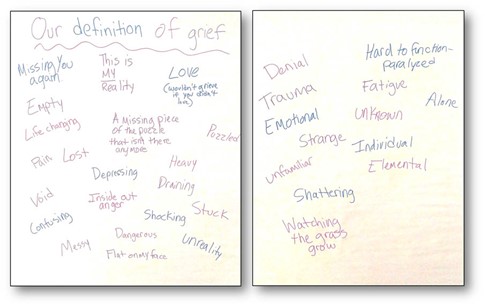
Our Definition of Grief

By Beth Bolthouse, MA, LPC (with help from the Monday Night Grief Healing Support Group)

One evening in June, the participants in our weekly “Grief Healing Support Group” got together and do what we always do – talk about our grief.

The remarkable thing about this group, however, is that it is not a sad, gloomy hour. Which may surprise some of you. When a person thinks about going to a grief group, that is usually the reaction (“I don’t want to go and be more sad”). Now that doesn’t mean that no one ever feels sad or gloomy while there. But the focus of this group is to be gut level honest, talk about the ways losing someone we loved (or at least knew, because it isn’t always about an actual “loved” one), has affected our life and changed the person we used to be to who we are now.

Most of the folks who come to group are still trying to figure that out. And almost all of them admit that people in their lives want them to go back to how they were – which is an impossibility. The death of the person who impacted their lives in one way or another has changed them and they cannot possibly be who they once were.

In fact, they don’t really know who they are now, or who they are going to be. They are just trying to sort through all the emotions and thoughts that have gone into this time in their lives and find ways to maneuver through the sometimes chaotic and crazy-making, other times numbing and depressing day-to-day, hour-by-hour, minute-by-minute grief experience.

The plan for group this night was to take time to define grief. What really impacted this particular evening were two folks who brought in their own ways of viewing grief, without being aware of what the plan was in advance. That’s one of the things I love about this group – people come as they are, and once in a while they bring a guitar, or a framed poem they wrote, or old photographs and we all get to be a part of their experience in a deeper way.

There are all kinds of deaths represented in this hour each Tuesday: spouse, parent, child, grandparent, sibling, friend. And there are all kinds of people represented through their varied cultural backgrounds, faiths, life experiences. But the one thing we all have in common is grief. With a capital G.

And the other thing we all have in common is we talk real – no one fakes their feelings, or hides their tears, or pretends things will be okay. Cuz truth be told, no one knows what tomorrow will be like, and perhaps just getting up and driving to group was all that a person could do today.

One of our group members likes to write songs to express his grief, so he passed out copies of lyrics and proceeded to share a song he wrote about his loved one and how his grief feels. Titled, “Missing You Again,” it expressed the heartfelt pain of his loss.

Perhaps you can relate to missing your someone – again – and again – because if we’re honest, the missing never stops. It may change in intensity, or we might have different things that remind us of him or her, but the reality is we never stop missing them because that is the way grief is.

It took us about an hour (and we could have gone on longer if we had stayed), but we came up with our own definition of grief – words and phrases that are the true life experience of at least one or more folks who were present that evening.

What about you?

How would you define your grief?

Do words or phrases come to mind? Or a song? Or perhaps you would create your definition through a drawing or sculpture?

It’s important to acknowledge the losses in our lives, and to find ways to identify how they affect us and use those things to define our individual grief.

Your losses matter.

Your griefs matter.

You are not alone. We are here to help.

Call us at the Scolnik Healing Center of Harbor Hospice at (231) 728-3442 if you would like to join one of our grief groups, or perhaps sit down with a grief counselor and begin (or continue) the process of defining your grief.