
By Beth Bolthouse, MA, LPC (with help from the Monday Night Grief Healing Support Group)
One evening in June, the participants in our weekly “Grief Healing Support Group” got together and do what we always do – talk about our grief.
The remarkable thing about this group, however, is that it is not a sad, gloomy hour. Which may surprise some of you. When a person thinks about going to a grief group, that is usually the reaction (“I don’t want to go and be more sad”). Now that doesn’t mean that no one ever feels sad or gloomy while there. But the focus of this group is to be gut level honest, talk about the ways losing someone we loved (or at least knew, because it isn’t always about an actual “loved” one), has affected our life and changed the person we used to be to who we are now.
Most of the folks who come to group are still trying to figure that out. And almost all of them admit that people in their lives want them to go back to how they were – which is an impossibility. The death of the person who impacted their lives in one way or another has changed them and they cannot possibly be who they once were.
In fact, they don’t really know who they are now, or who they are going to be. They are just trying to sort through all the emotions and thoughts that have gone into this time in their lives and find ways to maneuver through the sometimes chaotic and crazy-making, other times numbing and depressing day-to-day, hour-by-hour, minute-by-minute grief experience.
The plan for group this night was to take time to define grief. What really impacted this particular evening were two folks who brought in their own ways of viewing grief, without being aware of what the plan was in advance. That’s one of the things I love about this group – people come as they are, and once in a while they bring a guitar, or a framed poem they wrote, or old photographs and we all get to be a part of their experience in a deeper way.
There are all kinds of deaths represented in this hour each Tuesday: spouse, parent, child, grandparent, sibling, friend. And there are all kinds of people represented through their varied cultural backgrounds, faiths, life experiences. But the one thing we all have in common is grief. With a capital G.
And the other thing we all have in common is we talk real – no one fakes their feelings, or hides their tears, or pretends things will be okay. Cuz truth be told, no one knows what tomorrow will be like, and perhaps just getting up and driving to group was all that a person could do today.
One of our group members likes to write songs to express his grief, so he passed out copies of lyrics and proceeded to share a song he wrote about his loved one and how his grief feels. Titled, “Missing You Again,” it expressed the heartfelt pain of his loss.
Perhaps you can relate to missing your someone – again – and again – because if we’re honest, the missing never stops. It may change in intensity, or we might have different things that remind us of him or her, but the reality is we never stop missing them because that is the way grief is.
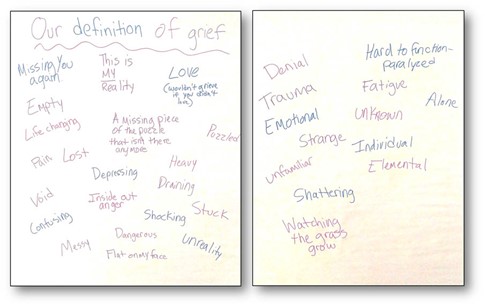
It took us about an hour (and we could have gone on longer if we had stayed), but we came up with our own definition of grief – words and phrases that are the true life experience of at least one or more folks who were present that evening.
What about you?
How would you define your grief?
Do words or phrases come to mind? Or a song? Or perhaps you would create your definition through a drawing or sculpture?
It’s important to acknowledge the losses in our lives, and to find ways to identify how they affect us and use those things to define our individual grief.
Your losses matter.
Your griefs matter.
You are not alone. We are here to help.
Call us at the Scolnik Healing Center of Harbor Hospice at (231) 728-3442 if you would like to join one of our grief groups, or perhaps sit down with a grief counselor and begin (or continue) the process of defining your grief.
 lifeinvestmentnetwork